The Snuff of Dreams
The Snuff of Dreams
A Single Owner Collection of Chinese Snuff Bottles
by Rosei Frost
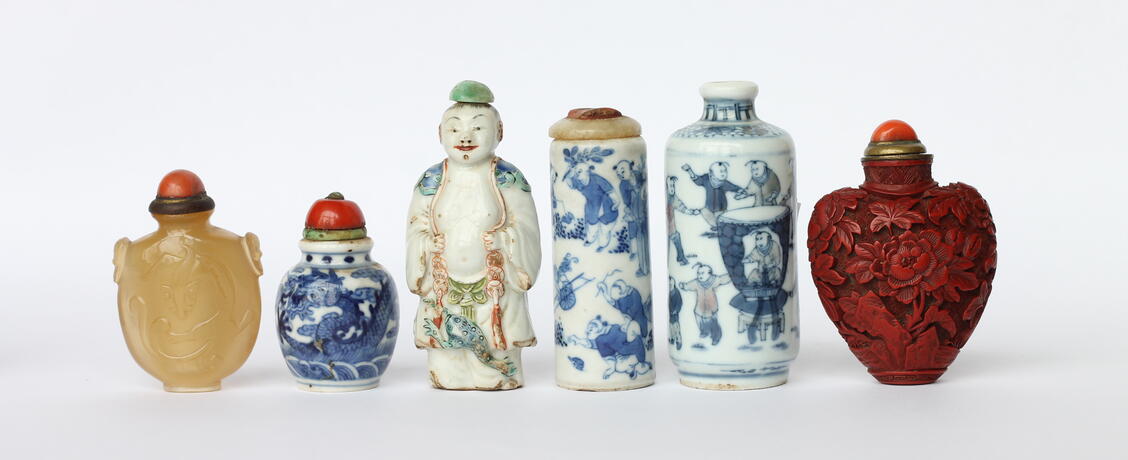
This October TW Gaze has the pleasure of hosting the first part of an Asian Collection, a single owner collection of Chinese works of art that were procured during 1930’s -60’s. A quarter of the sale comprises over fifty snuff bottles. These miniature containers, often measuring no higher than 8cm tall, have fascinated collectors for centuries and offer an insight into the historic trade relationship between China and Europe.
Snuff is finely ground tobacco that is sniffed up the nostrils and was an imported commodity that was discovered when Europeans began colonising the America’s. The history of snuff in China dates to the Kangxi emperor (1662-1722) who received gifts of snuff bottles from Jesuits who were converting people to Christianity in China. The Emperor set up his own Imperial workshop to produce these miniature artistic objects, and they have been sought, coveted and collected ever since. The royal association of taking snuff and the money it would cost to buy a bottle led to the bottles not only acting as practical vessels for carrying snuff, or even as decorative objects, but they were also viewed as a status symbol.
In the 21st century it is rare to know anyone who takes snuff; however, the bottles carry the hallmarks of astute collecting principles, small, easily transportable and each one acts as its own miniature piece of art. There are many elements that distinguish the bottles and make it an interesting collecting field, the different materials used to create the snuff (glass/ hardstone/ porcelain etc) to the form of each snuff bottle, the decoration and the time it was produced. The depictions on each bottle reflect the expansive field of Chinese art and range from historical moments, scenes from books or plays, to auspicious animals.
Mythological figures are also a theme and Zhong Kui makes an appearance on a few examples in the collection that will be sold on 30th October. Zhong Kui has his origins in a story of a man who excelled in his standard examinations that should have guaranteed him a high-ranking position, however upon seeing him, the Emperor was so repulsed by his physical appearance that he refused him. There are conflicting accounts regarding his demise, but he comes back as a demon-queller and is strongly associated with good fortune and as a repeller of bad spirits. He is often depicted wearing a hat with two long tails which assist him in his demon detecting activities.
Sometimes beauty is in the simplicity of design and the carved hardstone examples are excellent demonstrations that less is more. The process of hollowing out a hardstone bottle requires skill and adroitness to complete the task successfully regardless of the exterior decoration. The pale celadon double gourd (lot 6140) is the perfect embodiment of these techniques and mastery; beautifully rounded carvings form the double gourd with a hollowed foot and carved symbols to the neck that terminates in a delicate gilt lotus flower stopper.
One snuff bottle has, very literally, embodied its theme. A moulded soft paste porcelain bottle in the form of a man, Liu Hai, a Daoist immortal and a symbol of wealth and prosperity. Depicted standing with open-robed bare chest, holding his string of coins in each hand with a toad leaping at his feet. A very similar example resides in the Princeton University Art Museum collection and is dated as Jiaqing period (1796-1820).
Accompanying the snuff bottles will be a plethora of Chinese art to include a small quantity of carved jade open-work objects. The most awe-inspiring being a hat finial (lot 6118) depicting egrets amongst lotus foliage; every surface of the jade has been worked, delicately cutting segments in to leaves or tendrils. Another reticulated jade ware is a small rectangular plaque (lot 6102) carved as a dragon amongst scrolling foliage. The most difficult to estimate is a reticulated carved jade box cover (lot 6103); missing its base it has a double layer of intricately carved jade showing the ashtamangal (eight Buddhist emblems).
All the lots are offered from a single owner collection that was formed by Henry Potter Stevens, a prominent chemist who spent his spare time building an impressive collection of works of art. He bought from Glendining & Co, Sotheby’s and Christies and many items have provenances that span back to the mid 20thc from these sales.
Fully illustrated catalogue and details of viewing time can we found on here