Passing the Baton
Passing the Baton
By Elizabeth Talbot
We recognise truncheons as the short wooden clubs or batons traditionally brandished by police officers, but truncheons were carried by watchmen as early as the Middle Ages. From the establishment of parish constables in towns and cities across England during the reign of Edward I in the 13th Century, to the formation of the Victorian police by Robert Peel in the nineteenth Century, truncheons were a common symbol of authority and a means of protection for law enforcement across the land. This symbolism has been constant, whilst other elements of law and order has evolved over time.
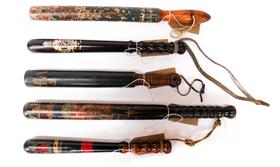
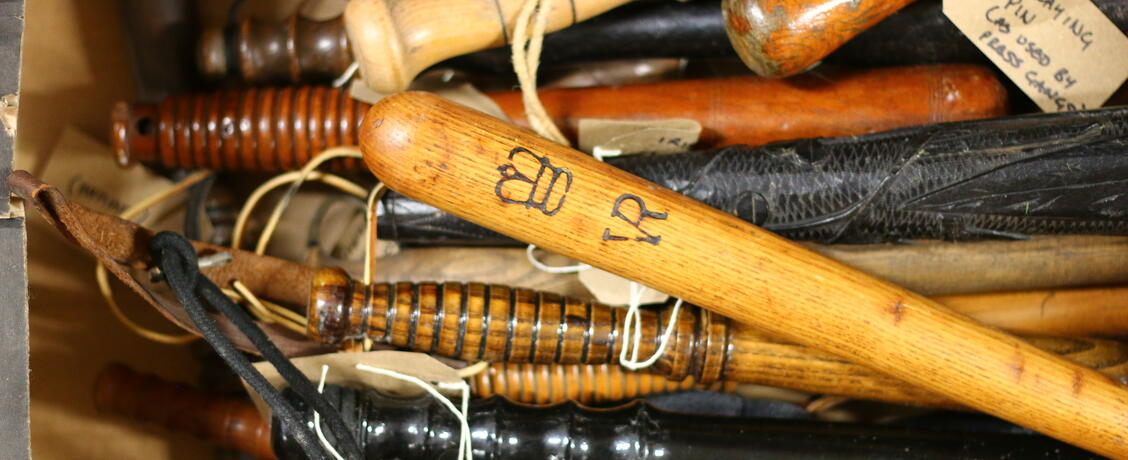
Truncheons were variously painted with constabulary motifs, Royal cyphers, local crests and sometimes the police officer’s rank, and the variation in decoration and design is enormous. Truncheons decorated with a Royal cypher demonstrated the officer’s authority, with the most ornate designs being reserved for tipstaffs, truncheon-like staffs which were often topped with a removable crown. Tipstaffs were carried by court officials who were specifically employed to keep order within court, and these officials, too, were known as Tipstaffs.
The subject of truncheons is broad and comprehensive. There is a whole variety of types to research or collect, including C.I.D pocket truncheons, Police women’s truncheons, handbag truncheons, Home Guard truncheons, riot batons, gamekeeper’s truncheons, railway truncheons, etc, not to mention regional variations of manufacture, including wood-turning and handle styles, which, rather like traditional furniture-making, often evolved from the capabilities of local craftspeople and artistic traits county-by-county.
Most truncheons are anonymous, but there are some which bear manufacturer’s names stamped into the wood, such as Hiatt from Birmingham, or Parker Field & Sons, 233 Holborn, London. A whole variety of woods have been used to make truncheons; usually durable hardwood rather than lighter softwood, but not so dense as to make the truncheon prohibitively heavy to carry. Originally, many truncheons were made from Lignum Vitae, a dense, heavy, dark wood from Central and South America. Antique truncheons made from Lignum Vitae are usually almost black in colour and are very distinctive. Lignum Vitae is now an endangered species, and truncheons have not been made from it for many years. Oak is perfect for making truncheons; with around 500 species around the world, oak truncheons often look very different from one another. The current version of the classic police design truncheon in the UK is made from Malaysian Oak (Rubberwood). It is a light-coloured medium-density tropical hardwood obtained from rubber trees grown in plantations, making it environmentally friendly. Meanwhile, beech, maple, ash and hickory examples are also found.
British police officers carried wooden truncheons that had changed very little from the traditional Victorian truncheon until the mid-1990’s when American-style collapsible batons became standard issue. This modern version serves a similar purpose but lacks character and individual uniqueness.
A private collection of nearly 60 truncheons is to be offered for sale in the next Militaria auction at TW Gaze Diss Auction Rooms on Tuesday 30th September, providing opportunity for the baton of ownership to be passed on. Many date from the Victorian period, with well-worn original decoration identifying sovereign or city, whilst the earliest bears the cypher of George IV. The collection perfectly illustrates the variety of shape and handle design and also contains a few Lignum Vitae examples.
Please see twgaze.co.uk for illustrated catalogue and contact specialist valuer Ed Taxil-Webber regarding future consignments (e.taxil-webber@twgaze.co.uk).