What a Snip!
What a Snip!
By Elizabeth Talbot
The history and development of much of our art and many of our artefacts throughout the world, whether royal, ecclesiastical, commercial or utilitarian, has been influenced by the practicalities of needing to communicate with populations, societies and communities, most of whom were unable to read. There is evidence that the Greeks, Romans and Egyptians all used forms of signage. In Britain, commoners would understand by the symbolism of heraldry who was landowner, knight or king; early folk for whom the written word was unfathomable would expertly understand Bible stories by studying gloriously illustrated stained glass windows, Sunday after Sunday; and town-dwellers identified shops and trading houses by the pictures and symbols hung outside the streets' buildings.
These latter are known as trade signs and were used extensively during the 16th to early 20th Centuries. They included oversized 3D models, such as a giant boot indicating a cobbler, or a coffee pot denoting a coffee house, and some identifiable examples survive into modern usage, including the three balls of the pawnbrokers, and the red and white pole of barbers. Alternatively, trade signs might be flat, decorated boards. Many of the painted pictorial signs for taverns, inns and pubs gained vernacular names based on eye-catching elements of the coats of arms which marked them, e.g. The Talbot, The Red Lion, The Crossed Keys, etc. Many are still in place well into the 21st Century.
The making of signs and signboards was an art form, often a collaboration involving carpenters, joiners, carvers, sign-painters, gilders and ironworkers. They were large and often of great artistic merit (especially in the 16th and 17th Centuries, when they were at the height of use and fashion), and the posts or metal brackets protruding over the streets, from which the signs hung, were often elaborately worked, and many beautiful wrought-iron examples still survive. Competition to have the most attractive sign was fierce, especially in large towns, where many premises practiced the same trade, and even more so where same trades congregated in the same street (such as in Haberdasher Street, Goldsmith Street, and Hosier Lane, in London); here, a simple trade sign was insufficient to distinguish one house from another. Thus, traders began to employ a variety of devices to differentiate themselves. Traders would use a variety of eye-catching and memorable methods to attract attention.
By Victorian times, shop signage was still important, and signwriting was still a great art form. However, there was evolution in terms of materials and levels of creativity, and it is from the 19th Century that some of the most exciting painted enamel signs emerge. These are highly prized in the 21st Century, being both scarce and much sought-after. Much has been lost to the ravages of time; some may have been repurposed. Redundant genuine old signage is difficult to store and look-after, yet it is surprising how the genre appeals to buyers when it appears on the open market. Museums, collectors, interior designers and retail fitters are keen to purchase, salvage and utilise these rare objects.
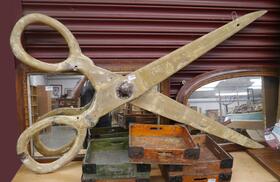
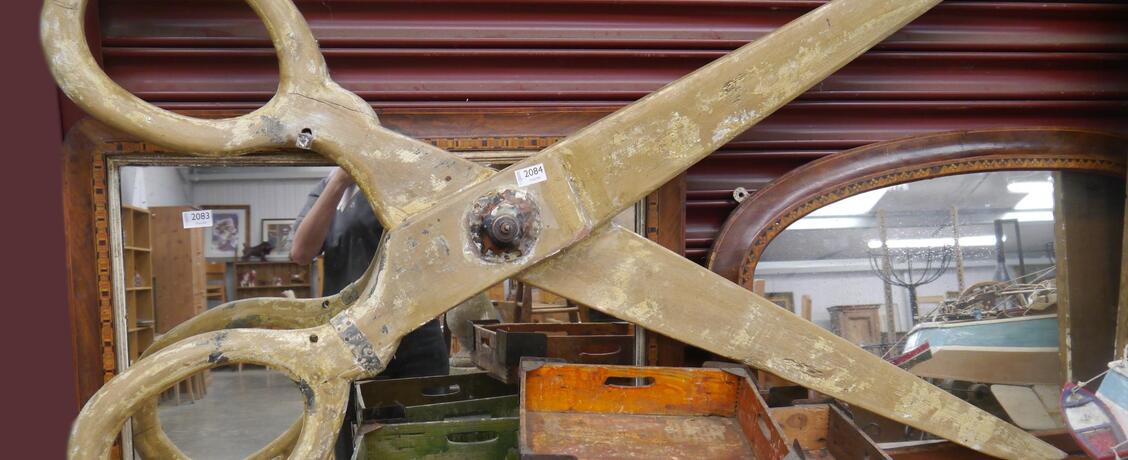
TW Gaze Diss Auction Rooms has sold a great many carved wood, painted enamel and ornamental metal trade signs over the decades in their sales specially focussed on social heritage and architectural history. The most recent example was a Victorian pine set of shop display scissors measuring a handsome 3' x 5' which sold in July. There are several suggestions as to what they may originally have advertised: hair salon, haberdashery or sewing shop, etc, but the specifics didn't seem to matter when the bidding eventually stopped at £850. What a snip for such an unusual artefact.
The next Rural Bygones auction in Diss is to take place on 18th September and there are already some interesting signs included, among them a highly colourful "Special Nosegay for Pipe or Cigarette" tobacco sign. Please see twgaze.co.uk for illustrated catalogue and contact sale organiser Robert Kinsella (r.kinsella@twgaze.co.uk) for valuation towards consignment to future auctions.