When Pictures Paint Words
When Pictures Paint Words
by Elizabeth Talbot
Susan Elizabeth Parkinson (1925 – 2012) was the daughter of a Calcutta-based wine merchant. When she was five the family returned to settle in Kent. She was a very artistic child and became a successful creative adult but struggled with academia and was diagnosed with dyslexia. In 1963, after being a working artist, she was given the opportunity to teach art at Brickwell House, a specialist school for dyslexic pupils in Northiam, East Sussex. Being able to relate to how her students approached their art enabled her to encourage and inspire them and they responded to her enthusiasm. She retired in 1982 but continued her quest for an explanation as to why a lack of ability with words was often accompanied by a higher-than-average success in visual-spatial skills.
She utilised an Open University degree course in research methods and statistics to become a specialist in this niche area. In 1992 she founded the Arts Dyslexia Trust with two teaching colleagues from Brickwell, with the intention of moving the focus away from “correcting” what are perceived weaknesses of dyslexic people and encouraging the high creative potential of visually dominant dyslexic minds instead.
The confidence Susan imparted to her art students and to those who approached the Arts Dyslexia Trust was a result of her own life-long achievements as an artist. After going to art school, she studied sculpture at the Royal College of Art. She was taught by Professor Frank Dobson (1886 – 1963; once considered one of the best sculptors in Europe), and Professor John Skeaping (1901 – 1980; a fine painter and sculptor of animals, known for his work with Wedgwood). Here she became the first sculpture student to win the Life Drawing Prize.
In 1949 she married potter Richard Parkinson; together they launched the Richard Parkinson Pottery company. They designed a whimsical lion and unicorn, originally intended to coincide with the 1951 Festival of Britain. Unable to produce in time, they refined it for the 1953 Coronation, had the design approved, added an EIIR monogram and achieved success.
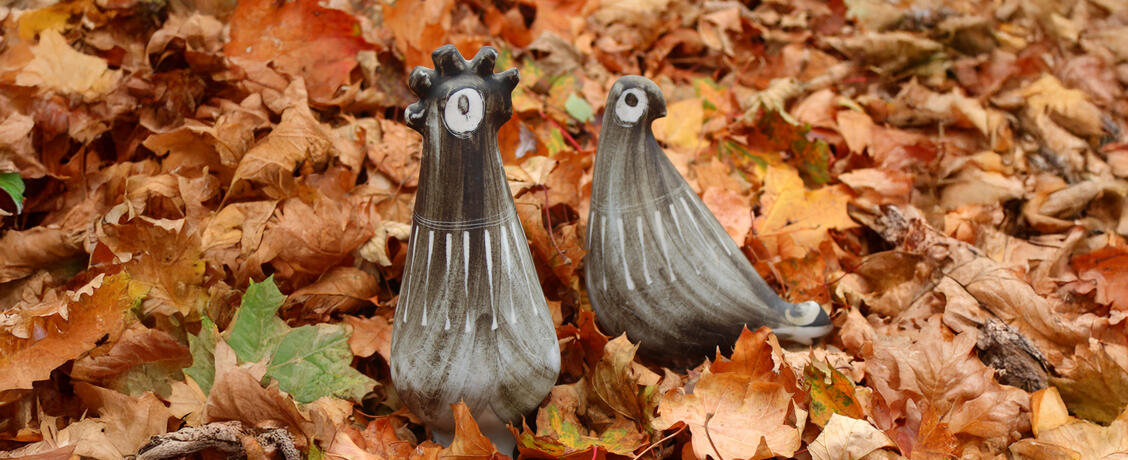
Then they launched a characterful cockerel and hen set. One was exhibited in Henry Rothchild’s Primavera Gallery in Sloane Street before being placed in the V&A’s Ceramic Study Galleries. Over forty years’ later, decorative art dealer Tim Smith-Vincent bought a second-hand example and became a passionate collector. In 2004 he co-wrote an overview of the couple’s creations with Carol Cashmore called “Susan Parkinson and the Richard Parkinson Pottery”. James Bassam references this in his forthcoming Modern Design Sale: “Lot 9171: Susan & Richard Parkinson Pottery cockerel and hen figures, model No.23 & 24. 30cm & 24cm high. Made while the pottery was at Brabourne Lees, Kent, 1951-1955 (See Cashmore & Smith-Vincent, p.20,95 etc) £150-300”.
Three other lots feature, also documented in the book:
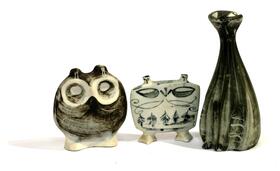
“Lot 9170: Two Susan & Richard Parkinson Pottery Little Owl figures, model No.46, mid 1950's. 7cm & 8.5cm high. (See Cashmore & Smith-Vincent, p.22,95 109 illus.) £100 – 150; Lot 9172: A Susan & Richard Parkinson Pottery figure of a Cat, model No.33, mid 1950's. 14cm high. (See Cashmore & Smith-Vincent, p.26, 104 illus.) £50 – 80; and Lot 9173: A Susan & Richard Parkinson Pottery mug, model No.152, made in 1961. 10cm high. (See Cashmore & Smith-Vincent, p.78, 79 illus.) £50 – 80”.
Their output was always modest in size and remained truly artisan; they favoured working in porcelain which presented difficulties in firing and proved expensive. This means pieces are relatively rare. Long-term commercial viability was always precarious and after the couple divorced in 1962 there was no future for the enterprise. It was after its closure that Susan devoted her energies to teaching life drawing and sculpture, and of course, her pioneering work towards understanding dyslexia.
Modern Design Sale: 10th November. Fully illustrated catalogue, viewing details and bidding instructions here