Fascinating Facts behind a Lightening Cough Cure
Fascinating Facts behind a Lightening Cough Cure
(N.B. other brands and products are available)
By Elizabeth Talbot
As festivities fade and chilly winter takes a firm hold of the new year, I have been distracted by fascinating entries into the next Railwayana and Bygones auction to be held at TW Gaze Diss Auction Rooms on 13th January. The sale has been collated over recent weeks by specialist valuer Robbie Kinsella, and there are many fascinating themes to explore, including a generous selection of Railwayana catalogued by Dan Woods, as well as tools, ephemera, vintage lawnmowers by Ransomes of Ipswich and their contemporaries, heritage artefacts, and enamelled signs.
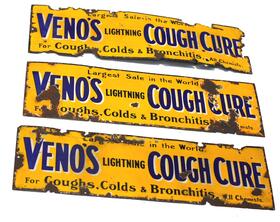
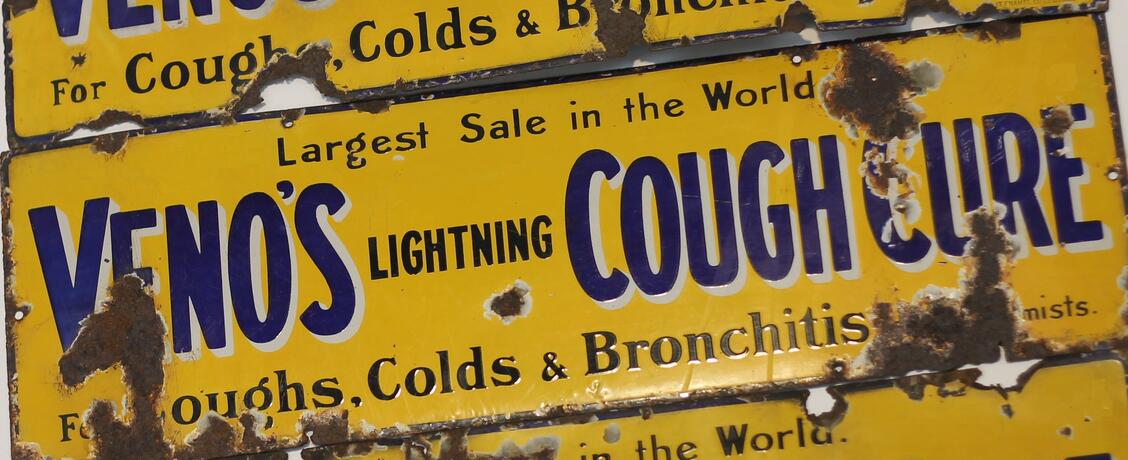
Given the plummeting temperatures at the time of my editorial deadline, I was particularly drawn to some enamelled signs advertising “Veno’s Lightening Cough Cure”.
Their story begins with the birth of William Reynard Varney near Castle Douglas in south-west Scotland on 22nd December 1866. By 1881 he and his parents were living in Wigtownshire, his father a gamekeeper and William a junior telegram operator. In 1884 he was employed as a cabin boy on a ship belonging to the Guion Line and sailed to America. It is reported that whilst there, in 1887, he discovered the recipe for a very effective cough mixture, possibly acquiring it from a Mr Veno. From 1889, Varney was in London pursuing an interest in politics but went back to America in 1891 to work in advertising before going to Pittsburgh, Pennsylvania, where he patented Veno’s Cough Cure on 24th August 1894 and began manufacturing it.
Somewhere between 1894 and 1896 he changed his name to William Henry Veno (and by deed poll in Britain in 1910) and in the summer of 1897 returned to England. Veno’s Lightening Cough Cure (or, Expectorant) was established: he founded the Veno Drug Company in 1898 and built a factory in the Old Trafford district of Manchester, which was proudly illustrated on his medicine bottles.
Veno himself is listed as a British pharmaceutical inventor, acknowledged for having created both Veno’s Cough Mixture and Germolene, but he was a multi-facetted character. During the First World War, motivated by his Scottish heritage, he was involved with recruitment and the “Manchester-Scottish” battalion, the 15th Battalion Royal Scots. After the war he set up the Leigh branch of the British Legion, owned a theatre in Manchester, was Mayor of Altrincham (1923/24) and was a prominent Freemason in London. In 1925 he sold his company to Beecham Estates and Pills Ltd and unsuccessfully re-invested some of his profit in photographic film companies.
He was ultimately knighted by King George V in 1920 and applied for and received a coat-of arms from the Lord Lyon. He died on 10th March 1933 from a self-inflicted gunshot wound whilst shooting rabbits on his estate in Cheshire and is buried near Manchester. Meanwhile, Veno’s is still a familiar sight on the shelves of chemists and supermarkets and is one of Britain’s longest-running brand names.
Coincidentally, the history of Veno’s is closely aligned to the timeline for the development of vitreous enamel and it’s use by the advertising industry. Enamelled signs were displayed on trams, buildings, railway stations, and shop walls, not uncommonly in shapes and sizes designed for specific places such as beneath windows or beside doorways. The first commercial production began in Birmingham in 1859 when Benjamin Baugh patented the process for producing vitreous enamelled signage and the first dedicated factory was opened in 1889, also in Birmingham, by the Patent Enamel Company. They remained a significant promotional device until the 1960’s when alternative forms of advertising, including television, began to dominate.
Enamelled signs have been much copied because their value and collectability has increased over the years, but the five Veno signs here are genuine and are to be sold in three lots with a total value of £250 – 380. They sit alongside other enamel signs in the auction.
Fully illustrated catalogue, plus viewing and bidding information, at twgaze.co.uk.